
Losing a tooth changes more than your smile. It changes how you chew, how you speak, and — if left unaddressed — how your jaw and surrounding teeth behave over the following years. The two most common tooth replacement options your dentist will discuss are dental implants and dental bridges. Both restore the visible gap. Both look natural. But they work in fundamentally different ways, carry different long-term consequences, and suit different types of patients.
This guide gives you the honest, side-by-side comparison you need to walk into a consultation already knowing which direction makes sense for your situation.
What Is a Dental Implant?
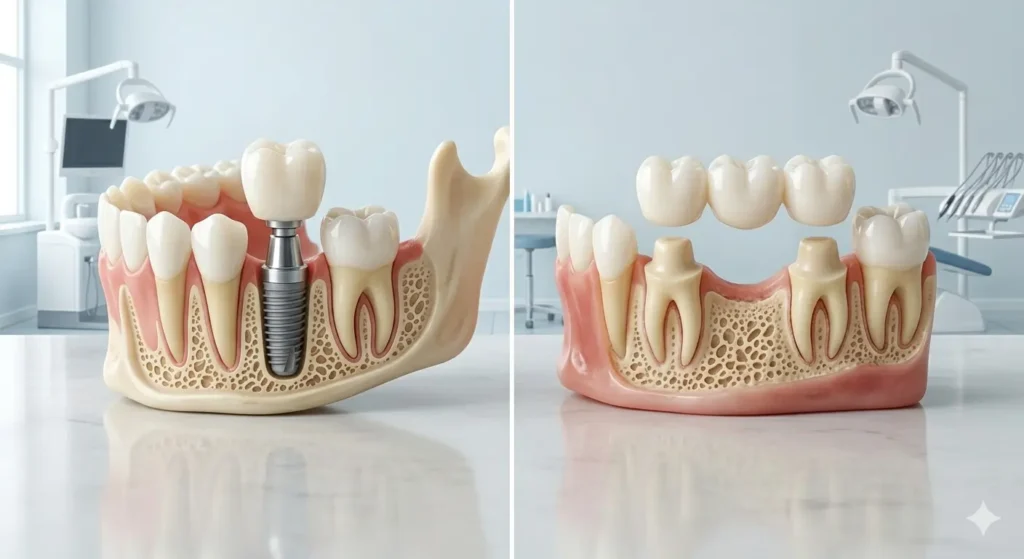
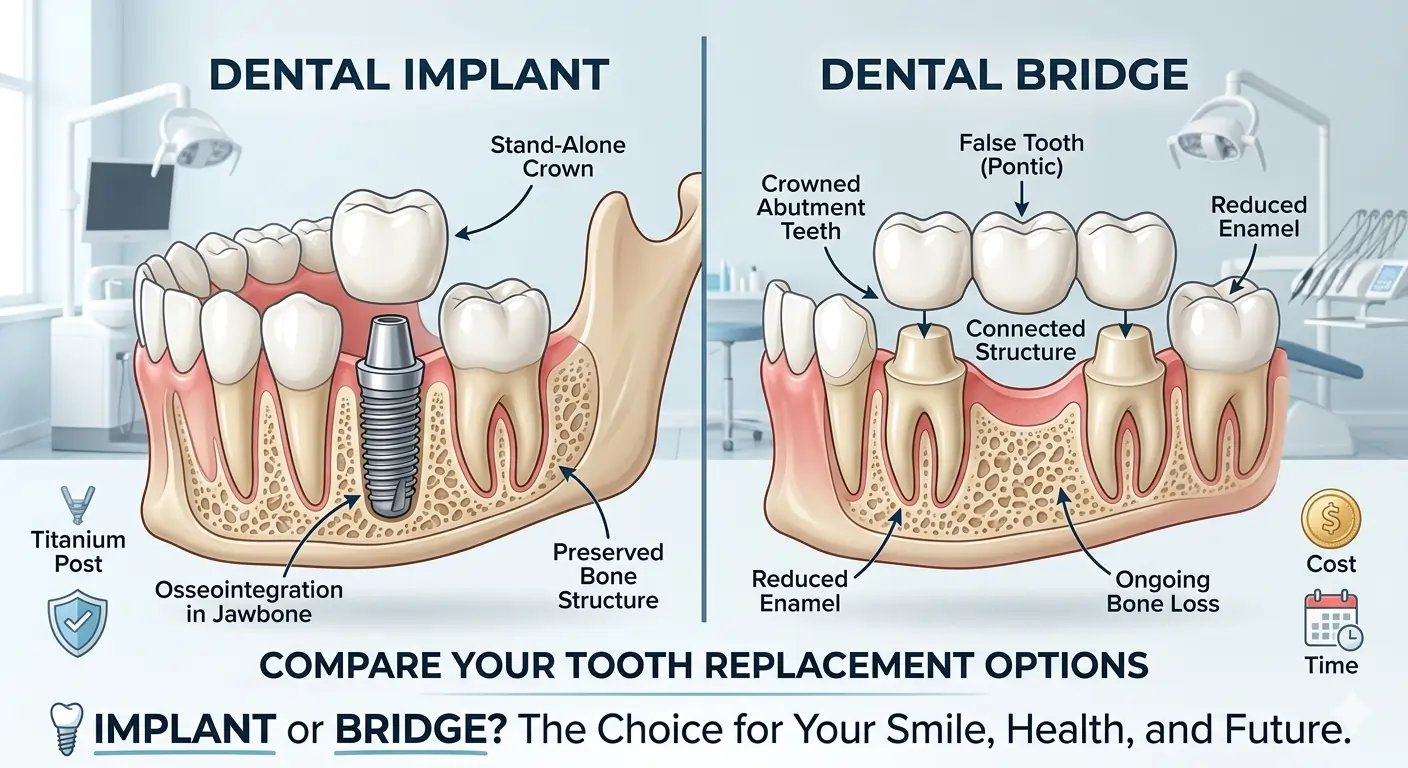
A dental implant is a titanium post surgically placed into the jawbone to act as an artificial tooth root. Over the course of three to six months, the post fuses with the surrounding bone through a biological process called osseointegration — creating a foundation as stable as a natural root. A porcelain crown is then attached to the top of the implant, completing the visible tooth.
The result: a standalone, fully independent tooth replacement that does not affect the teeth beside it in any way.
At Madison Dental Care in Madison, AL, dental implants are among our most requested services — and for most qualifying patients, they are our first clinical recommendation for single tooth replacement.
What Is a Dental Bridge?
A dental bridge “bridges” the gap left by a missing tooth using a false tooth (called a pontic) suspended between two dental crowns. Those crowns are cemented onto the two healthy teeth flanking the gap — called abutment teeth — after those teeth have been permanently filed down to accept them.
The result: a fixed, non-removable prosthetic that replaces the missing tooth — but at the cost of altering two teeth that were previously healthy.
Dental bridges at Madison Dental Care remain a proven, effective treatment option — particularly for patients who are not surgical candidates or who need a faster solution.
Dental Implant vs. Bridge: Full Comparison
| Factor | Dental Implant | Dental Bridge |
|---|---|---|
| Impact on adjacent teeth | None | Requires permanent reduction of healthy teeth |
| Jawbone preservation | Yes — prevents bone loss | No — bone loss continues under gap |
| Average lifespan | 25+ years (often lifetime) | 10–15 years |
| Feel | Identical to a natural tooth | Natural, but bridge can flex slightly over time |
| Oral hygiene | Brush and floss normally | Requires floss threader or water flosser under the pontic |
| Upfront cost (Alabama) | $3,000–$5,500 per tooth | $1,500–$3,000 for a three-unit bridge |
| 20-year total cost | $3,000–$5,500 (typically once) | $3,000–$6,000+ (replacement likely) |
| Surgery required | Yes | No |
| Treatment timeline | 3–6 months | 2–3 weeks |
The Issue Most Patients Don’t Know About: Jawbone Loss
This is the most important difference — and the least discussed in casual conversations about tooth replacement.
When a natural tooth root is lost, the jawbone beneath it no longer receives mechanical stimulation. The body interprets this as a signal that the bone is no longer needed and begins resorbing it. Research published in the International Journal of Oral & Maxillofacial Implants found that the alveolar bone can lose up to 25% of its width within the first year following tooth extraction, with continued loss over subsequent years.
A dental implant replicates the mechanical function of a natural root — transmitting chewing forces into the bone and maintaining its density and volume. A dental bridge sits above the gumline and provides zero stimulation to the bone underneath the pontic. Bone loss under a bridge is slow but cumulative, and over years it can cause the ridge to flatten, the bridge fit to shift, and the facial profile to subtly change.
For patients in their 30s, 40s, or 50s choosing between an implant and a bridge, this long-term bone biology is often the deciding factor.
The Hidden Cost of a Bridge: Your Neighbouring Teeth
To place a bridge, two perfectly healthy teeth — the ones immediately adjacent to your gap — must be permanently ground down by approximately 60–70% of their structure. Once done, this cannot be undone. Those teeth are now permanently crowned and permanently bonded to the bridge. If the bridge ever fails, chips, or needs replacement, those neighbouring teeth are involved in the repair or replacement — and they are weakened with each successive restoration.
A 2017 systematic review in the European Journal of Oral Implantology reported a 10-year bridge survival rate of approximately 89.4%. That is a strong outcome — but it also means roughly 1 in 10 bridges will need significant intervention within a decade, typically involving those abutment teeth.
For patients with healthy, cavity-free neighbours, this is a significant consideration. Choosing an implant preserves those teeth entirely.
When a Bridge Is the Better Choice
A bridge is a clinically appropriate and excellent option in several scenarios:
- You need a tooth replaced within weeks, not months (surgical healing makes implants slower)
- You have insufficient jawbone density and are unwilling or unable to undergo bone grafting
- The adjacent teeth already need crowns — in which case a bridge becomes a clinically efficient solution
- You have a medical condition that makes surgery inadvisable
- Budget makes the lower upfront cost of a bridge the practical constraint right now
Our restorative dentistry team will always discuss bridge candidacy honestly alongside implants — both options deserve a thorough evaluation.
When an Implant Is the Better Choice
- You want to preserve healthy adjacent teeth without altering them
- Long-term bone health and facial structure are priorities
- You want the most natural-feeling, longest-lasting result available in modern dentistry
- You’re making a lifetime investment and want to avoid future replacement costs
- You’re a suitable surgical candidate with adequate bone (or willingness to graft)
What About Cost Over Time?
The upfront price difference is real — implants cost more. But evaluated over 20 years, the math often reverses. A bridge placed at age 40 may need replacement at 52 and again at 65. Each replacement involves the abutment teeth, potential crown work, and lab fees. An implant placed at 40 may never need replacement.
For a detailed breakdown of implant pricing in Alabama, read: How Much Do Dental Implants Cost in Alabama?
FAQs
Q1. Is it better to get an implant or a bridge?
A: For most healthy adults who are surgical candidates, a dental implant is the superior long-term solution — it preserves bone, leaves adjacent teeth untouched, and typically outlasts a bridge by 10–15 years or more. A bridge is better suited for patients who need speed, have healthy adjacent teeth already requiring crowns, or cannot undergo surgery.
Q2. How long does a dental bridge last compared to an implant?
A: Dental bridges typically last 10–15 years before requiring replacement. Dental implants, when placed correctly and maintained with good oral hygiene, have documented survival rates exceeding 97% at 10 years and can last 25+ years or the patient’s lifetime.
Q3. Can a bridge be replaced with an implant later?
A: In many cases, yes — though it depends on the bone density remaining in the area. If significant bone loss has occurred under the bridge site, bone grafting may be required before implant placement.
Q4. Does a dental bridge feel natural?
A: Yes, a well-made dental bridge feels very natural. However, cleaning requires extra steps (floss threaders or water flossers), and some patients notice a slight difference compared to their natural teeth.
Your Next Step in Madison, AL
The only way to know definitively which option is right for you is a thorough clinical assessment — one that looks at your bone density, the health of your adjacent teeth, your medical history, and your long-term goals.
At Madison Dental Care, we offer implant consultations and restorative assessments for new patients. No pressure. No commitment. Just clarity.