

If you’re missing teeth and researching your options, you’ve probably landed on this same question: implants or dentures? Both replace missing teeth. Both restore your ability to eat and smile. But beyond that, they’re remarkably different in how they work, how they feel, and what they cost over time.
This guide is designed to cut through the noise and give you an honest, side-by-side comparison — so you can walk into a consultation already knowing which direction feels right for you.
What Are Dental Implants?
A dental implant is a titanium post surgically placed directly into your jawbone, acting as an artificial tooth root. Once it integrates with the bone (a process called osseointegration), a crown is attached on top. The result looks, feels, and functions exactly like a natural tooth.
Implants can replace a single tooth, multiple teeth, or — through solutions like All-on-4 full mouth restoration — an entire arch of teeth anchored by just four strategically placed implants.
What Are Dentures?
Dentures are removable appliances that sit on top of the gumline and replace missing teeth. Traditional full dentures replace an entire arch. Partial dentures replace several missing teeth when healthy teeth remain. They rely on suction, adhesive, or clasping onto existing teeth for stability.
Implant-supported dentures are a hybrid solution: a full denture that snaps onto implants for much greater stability than conventional dentures.
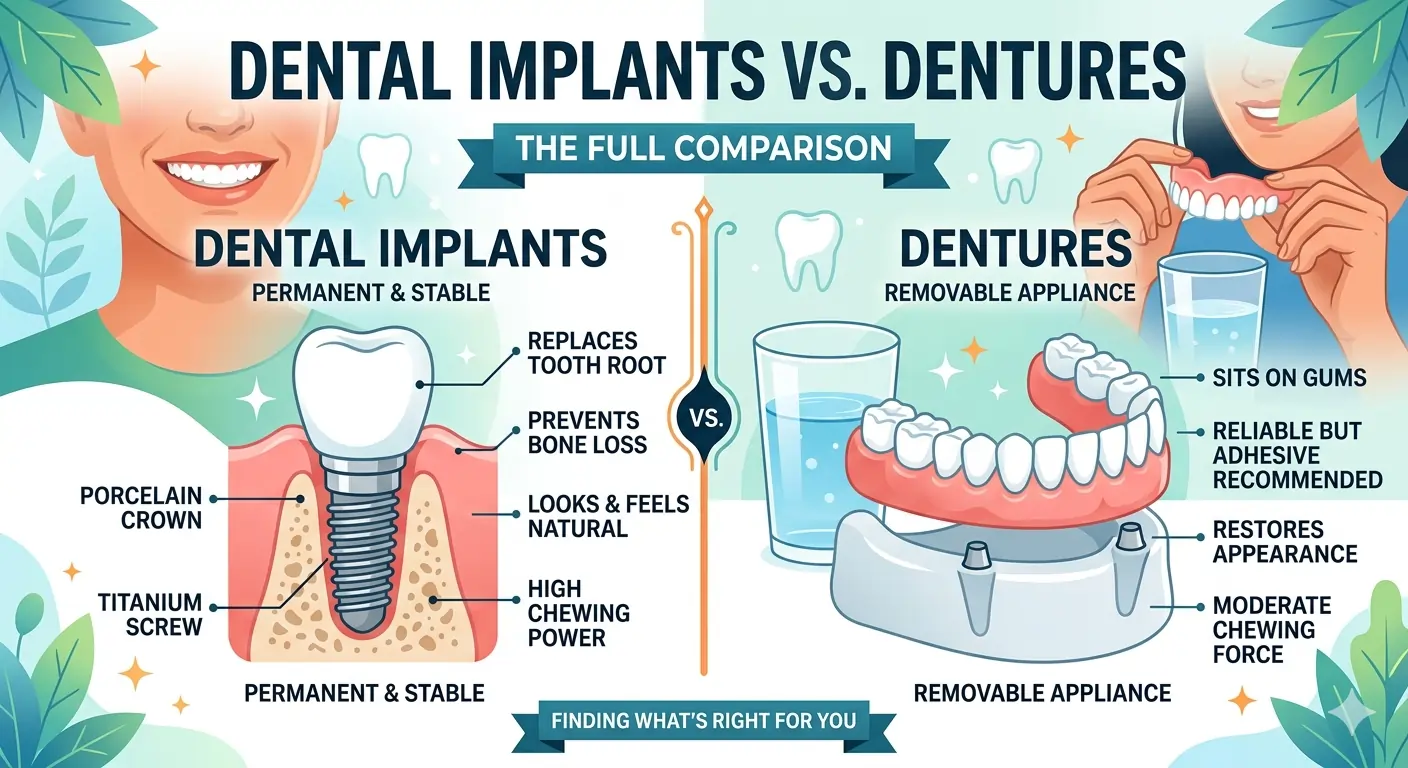
Head-to-Head Comparison
Comfort and Feel
Dental implants feel indistinguishable from natural teeth. You don’t remove them, you don’t feel them shifting, and there’s no palate-covering plastic affecting your taste.
Traditional dentures, by contrast, can feel bulky, may slip during eating or speaking, and often require adhesive to stay in place. A 2021 survey published in the Journal of Prosthetic Dentistry found that patients with implant-supported restorations reported significantly higher satisfaction scores for comfort, chewing ability, and confidence than those with conventional dentures.
Chewing Power
Natural teeth exert roughly 200–250 pounds of chewing force. Dental implants restore nearly the same level. Conventional dentures typically restore only 10–25% of natural chewing force — meaning many foods (steak, apples, nuts, hard bread) become difficult or off-limits.
Bone Preservation
This is one of the most important and least-discussed differences. When a tooth root is lost, the jawbone underneath begins to resorb (shrink) because it no longer receives stimulation. A clinical study in the International Journal of Implant Dentistry found that within the first year after tooth loss, bone loss in the jaw can be as high as 25%.
Dental implants stimulate the jawbone the way natural roots do, halting and preventing this bone loss. Dentures sit on top of the gum and provide no bone stimulation — meaning jawbone loss continues and can lead to facial changes over time (the sunken-cheek appearance some denture wearers develop).
Lifespan and Maintenance
| Dental Implants | Conventional Dentures | |
|---|---|---|
| Lifespan | 20–30+ years (often lifelong) | 5–10 years before replacement |
| Daily care | Brush and floss like natural teeth | Remove and soak nightly |
| Adhesive needed | No | Often yes |
| Bone loss prevention | Yes | No |
| Adjustments over time | Minimal | Frequent (as gums change shape) |
Cost Comparison
Implants cost more upfront — but when compared across a 15–20 year timeline, they are often comparable to or less expensive than multiple rounds of denture replacements and relining. For full-arch solutions, All-on-4 implants at Madison Dental Care offer a permanent, stable solution at a more accessible price than replacing each tooth individually.
Who Is a Good Candidate for Dental Implants?
Most adults in reasonably good health are candidates. The key requirements are sufficient jawbone density (or willingness to undergo bone grafting) and healthy gum tissue. Conditions like uncontrolled diabetes or active gum disease need to be addressed first.
The general dentistry and implant teams at Madison Dental Care can assess your candidacy at a free consultation.
Who Might Be Better Served by Dentures?
Patients who are medically unable to undergo surgery, those with severely compromised bone that cannot support implants, or patients for whom budget is the primary limiting factor in the short term may find conventional dentures are the right starting point — with implants as a future goal.
For patients who are candidates, dental implants are the closest thing to natural teeth that modern dentistry offers. Dentures are a viable option, but they come with real trade-offs in comfort, bone health, and long-term cost.
The best way to know which option is right for you is a face-to-face assessment with an implant dentist who can review your bone structure, overall health, and budget. Call Madison Dental Care at (256) 772-2626 to Book a Free Implant Consultation at Madison Dental Care