
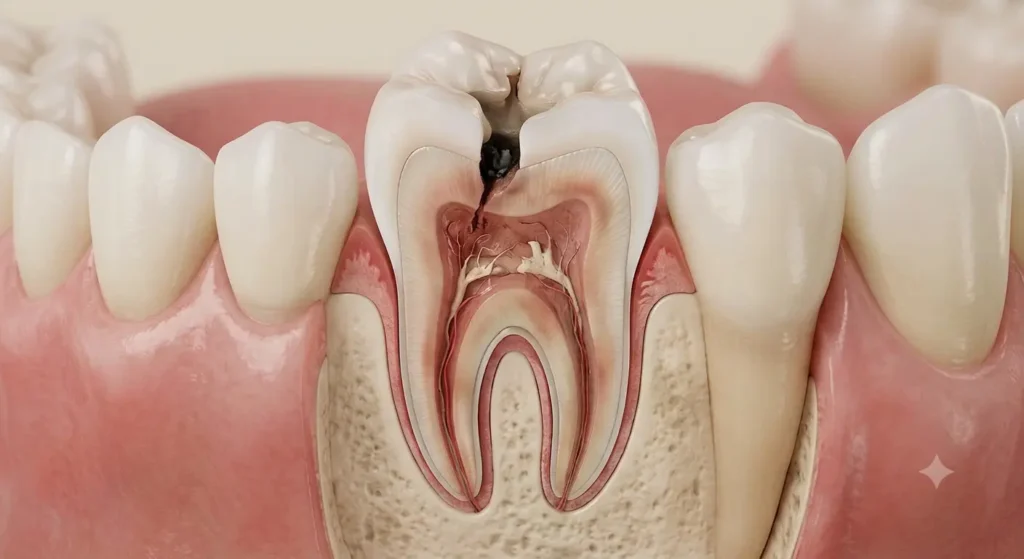
“Root canal” is one of the most feared phrases in dentistry — and one of the most misunderstood. Here’s what most people get backwards: it’s the infection that causes the severe pain, not the root canal procedure itself. The root canal removes the source of that pain.
Recognising the warning signs early is the difference between a routine procedure and a dental emergency that threatens the tooth entirely. Below are the seven symptoms that should send you to your dentist — and why ignoring them consistently makes things worse, not better.
Understanding What a Root Canal Treats
Inside every tooth, beneath layers of enamel and dentin, is a chamber of soft tissue called the dental pulp — containing nerves, connective tissue, and blood vessels. When bacteria penetrate the pulp through a deep cavity, a crack, or dental trauma, the pulp becomes infected and inflamed.
The body cannot resolve this infection on its own. Left untreated, it spreads from the pulp into the surrounding periodontal ligament, into the jawbone, and potentially into systemic circulation. A root canal procedure removes the infected pulp, disinfects the root canals, seals them permanently, and — in the vast majority of cases — saves the natural tooth.
The American Association of Endodontists reports a root canal success rate of over 95% when performed by a skilled clinician, making it one of the most reliable procedures in dentistry.
Sign #1: Severe, Persistent Toothache
A sharp, throbbing, or relentless toothache — particularly one that radiates into the jaw, ear, or adjacent teeth — is the most common symptom of pulpal infection. The key distinction from ordinary sensitivity: the pain doesn’t go away on its own.
Normal dental sensitivity resolves within seconds after the stimulus (a cold drink, a bite of food). Pulpal pain lingers, intensifies, and often worsens at night when lying down — because horizontal positioning increases blood pressure in the head, amplifying the pressure inside the inflamed pulp chamber.
Over-the-counter pain relievers may dull the sensation temporarily. They do not address the infection. The pain will return, and it will worsen.
Sign #2: Prolonged Sensitivity to Heat or Cold
Brief sensitivity to cold is common and usually not a root canal indicator. The flag is lingering sensitivity — when a tooth remains sensitive to temperature for 10 seconds, 30 seconds, or minutes after the stimulus is removed.
Persistent heat sensitivity, in particular, is a highly specific indicator of irreversible pulpitis (inflammation of the pulp). Unlike cold sensitivity, which can have benign causes, sensitivity to hot temperatures that persists after the hot substance is removed is a strong clinical indicator that root canal treatment is needed, according to guidelines from the American Association of Endodontists.
Sign #3: Tooth Discolouration or Darkening
A single tooth that is visibly darker than the ones beside it — grey, brown, or increasingly black — is often a tooth whose internal nerve is dying or dead. This discolouration is caused by the breakdown of haemoglobin in the pulp tissue, which produces dark pigment compounds that stain the dentin from the inside.
Importantly, a dying tooth may not be painful in the early stages of nerve death. Absence of pain does not mean absence of infection. A tooth that looks dark deserves a dental examination — even if it feels fine.
Sign #4: Swelling in the Gum, Jaw, or Face
A raised, fluid-filled bump on the gumline near a painful tooth is called a dental abscess — a pocket of bacterial infection that has broken through the root apex and accumulated in the surrounding tissue. It may look like a pimple, feel tender when pressed, or ooze a bitter-tasting fluid.
A dental abscess is an active bacterial infection. It does not resolve without treatment. In rare but documented cases, an untreated dental abscess can spread to the floor of the mouth, the neck, or — most dangerously — the airway, in a condition called Ludwig’s angina.
If facial swelling extends to your neck, jaw, or eye area, seek emergency medical care immediately. For tooth-localised swelling, contact your dentist the same day.
For urgent dental situations in Madison, AL, our emergency dentistry team is available for same-day appointments.
Sign #5: Sharp Pain When Biting or Applying Pressure
When the infection inside a tooth spreads beyond the pulp and into the periodontal ligament — the fibrous tissue that anchors the tooth to the jaw — the act of biting becomes painful. The tooth may feel tender even when touched lightly with your tongue.
This is a sign that the infection has progressed to the surrounding bone and tissue. At this stage, the tooth may be saveable, but treatment is more complex than it would have been earlier. Pain on biting that is localised to one tooth is an urgent clinical signal.
Avoid chewing on that side and contact your dentist that day. Do not wait to see if it resolves.
Sign #6: A Cracked or Fractured Tooth
Cracks in teeth — from biting hard foods, sports trauma, or chronic teeth grinding — can create a pathway for oral bacteria to reach the pulp. Not all cracks require a root canal; the critical variable is how deep the crack extends.
A crack confined to the enamel can often be treated with bonding or a crown. A crack extending into the pulp chamber requires a root canal before a crown is placed. A crack extending below the gumline into the root may mean the tooth cannot be saved at all — making early intervention critical.
If you’ve cracked or chipped a tooth and experience any of the other symptoms on this list, contact your dentist the same day. Our general dentistry team can assess crack depth with imaging and direct examination.
Sign #7: A Loose Adult Tooth
An adult tooth that has become loose — without trauma or an obvious cause — may be experiencing bone loss driven by a spreading infection. The periodontal ligament fibres that anchor the tooth weaken as bacteria degrade the surrounding tissue.
When a loose tooth occurs alongside pain, temperature sensitivity, or swelling, the infection pathway from the pulp is the likely culprit. A loose tooth in an adult requires immediate evaluation — regardless of whether the loosening is painful.
What Happens If You Ignore These Symptoms?
This question deserves a direct answer: the infection does not go away. A tooth with an infected pulp is not capable of healing itself. The bacterial process continues whether or not pain is present, and the consequences escalate over time:
- Early stage: Pulp inflammation — reversible with treatment, no root canal needed
- Progressive stage: Irreversible pulpitis — root canal required to save the tooth
- Advanced stage: Periapical abscess — root canal becomes more complex; bone loss begins
- Late stage: Systemic spread or tooth loss — extraction becomes necessary; now an implant or bridge is needed to replace the lost tooth
Each stage is more expensive and more invasive than the one before it. A root canal that costs $900–$1,200 today becomes a tooth extraction, implant, and crown costing $4,000–$5,500 — or a dental bridge requiring the alteration of adjacent healthy teeth.
The decision to treat promptly is almost always the right one clinically and financially.
Does a Root Canal Hurt?
The procedure itself — properly numbed with modern local anaesthetic — should cause no more discomfort than a routine filling. Most patients report that the anticipatory anxiety is significantly worse than the treatment itself.
For patients with dental anxiety, sedation options including nitrous oxide and oral sedation are available at Madison Dental Care. You do not have to white-knuckle your way through treatment.
FAQs
Q1: How do I know if I need a root canal or just a filling?
A: A filling treats decay that has not reached the pulp. A root canal is needed when decay, a crack, or trauma has allowed bacteria to infect the pulp itself. Signs that the pulp is involved include spontaneous pain, lingering temperature sensitivity, and swelling. Imaging and clinical testing by your dentist provide a definitive answer.
Q2: Can a tooth that needs a root canal heal on its own?
A: No. Once the pulp is infected, the infection cannot resolve without treatment. Symptoms may temporarily reduce if the nerve dies (the tooth stops “reporting” pain), but the infection continues to spread silently.
Q3: How long can you wait for a root canal after symptoms start?
A: Every situation is different, but dental infection is not a condition to delay. A few days to manage a consultation is reasonable; weeks to months significantly increases the risk of bone loss, systemic spread, and tooth loss.
Q4: Is it better to pull a tooth or get a root canal?
A: Root canal treatment followed by a crown saves the natural tooth — almost always the preferred clinical outcome. Natural tooth roots stimulate the jawbone and maintain facial structure. Extraction followed by implant placement is a viable backup, but preserving the original tooth is the first choice when it’s achievable.
Don’t Wait on Tooth Pain in Madison, AL
If you’re experiencing any of the symptoms above, the most important thing you can do is call today. At Madison Dental Care, we see patients with urgent tooth pain as quickly as possible — including same-day appointments when available.
Book an Urgent Appointment in Madison, AL