
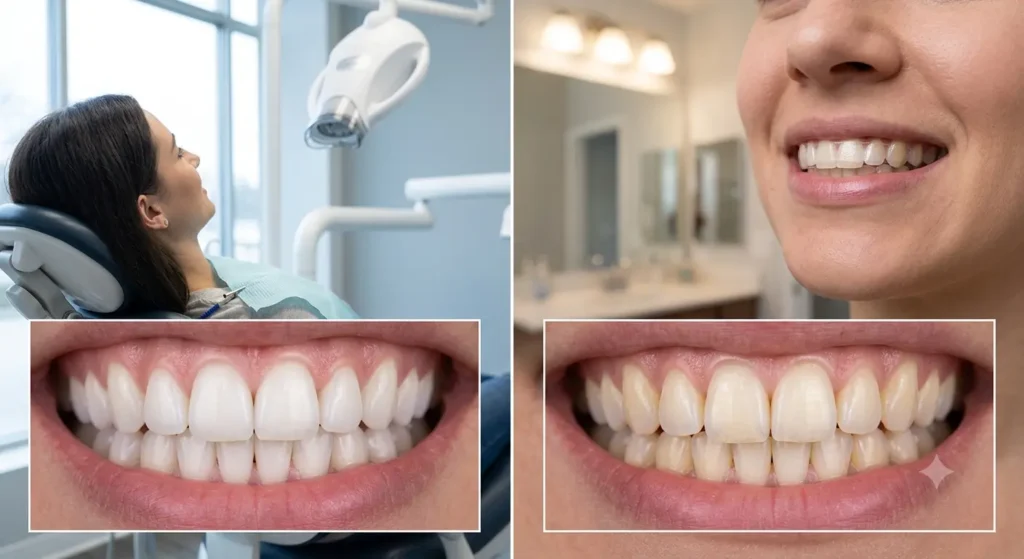
The teeth whitening market generates over $7 billion annually in the United States alone. There are strips, trays, LED kits, charcoal powders, whitening toothpastes, and in-office laser treatments — and every single one promises a brighter, whiter smile.
The honest question most consumers don’t ask is: which of these actually works — and which is just marketing?
This guide cuts through the noise with evidence-based answers, a head-to-head comparison of professional whitening versus consumer strips, and a clear recommendation based on your specific whitening goals.
How Teeth Whitening Works: The Core Mechanism
Whether you’re using a $30 box of Crest Whitestrips or a professional in-office treatment, all clinically effective whitening products share the same mechanism: peroxide-based oxidation.
Hydrogen peroxide (or its precursor, carbamide peroxide) penetrates through the enamel surface and into the dentin layer below, where it oxidises the long-chain pigment molecules that cause discolouration. Those pigment chains break apart, and the tooth reflects more light — appearing whiter.
The crucial variables between professional and OTC products are:
- Peroxide concentration — how much bleaching agent is delivered
- Contact uniformity — how evenly the agent touches every surface of every tooth
- Treatment duration and frequency — how long and how often the active ingredient is working
- Professional oversight — whether sensitivity is managed and progress is monitored
Over-the-Counter Whitening Strips: What They Can and Can’t Do
Consumer whitening strips — the most popular OTC whitening format in the US — use hydrogen peroxide at concentrations typically ranging from 6% to 14%. This range is FDA-regulated for consumer safety.
What Strips Do Well
- Remove surface staining from coffee, tea, red wine, and tobacco for patients with mild-to-moderate discolouration
- Deliver measurable whitening improvement of 1–3 shades with consistent use over 1–2 weeks
- Provide a genuinely accessible and convenient entry-point for whitening
- Work reasonably well for patients with naturally uniform enamel and minimal sensitivity
Where Strips Fall Short
Coverage gaps. Strips are pre-cut to a standard tooth shape. Human teeth are not standard. The result is almost always incomplete contact along the gumline (where discolouration is most visible), between teeth, and in any area where the strip doesn’t conform to the natural contours of enamel.
Concentration ceiling. Federal regulations cap OTC peroxide concentrations well below what dentists can prescribe. Higher concentrations produce faster, deeper whitening — this capability simply doesn’t exist in the consumer product category.
Surface-only results. At lower concentrations, bleaching agents don’t fully penetrate into the dentin layer where deeper staining lives. Strips are effective at removing extrinsic (surface) staining; they are less effective at addressing intrinsic staining.
Faster fading. OTC results typically begin to fade within 3–6 months without maintenance use.
Professional Teeth Whitening: What It Delivers
Professional whitening at Madison Dental Care uses prescription-strength peroxide concentrations — typically 25–40% for in-office treatment — applied under controlled, clinical conditions.
In-Office Whitening (Single Session)
A highly concentrated whitening gel is applied directly to the teeth, sometimes with a specialised light to accelerate the chemical reaction. Most patients achieve 6–10 shades of improvement in a single 60–90 minute session.
This is the option for patients who need maximum results before a wedding, a reunion, or any significant event where time is a factor.
Professional Take-Home Trays
Custom-fitted whitening trays are made from precise impressions of your teeth. They hold a professional-strength gel — typically 10–22% carbamide peroxide — in tight, even contact with every contour of every tooth.
Used daily for 1–2 weeks at home, professional take-home trays produce results comparable to in-office treatment in terms of final shade — with slightly longer timeline but greater flexibility.
The key advantage of custom trays over strips: the custom fit ensures 100% coverage of the tooth surface, including the gumline, between teeth, and the inner edges. No strips can replicate this — the difference in uniformity of result is visible.
Head-to-Head: What the Research Says
A 2021 clinical study published in the Journal of Dentistry compared whitening outcomes across OTC and professional systems.
The findings:
- Professional systems produced 2–3 times greater shade improvement than equivalent OTC products over matched treatment periods
- Sensitivity profiles were comparable when professional treatments were managed with desensitizing protocols
- Longevity was significantly greater for professional treatments — results lasted 12–24 months compared to 3–6 months for OTC strips before clinically significant fading
A separate 2019 Cochrane systematic review on tooth whitening found that higher-concentration professional products produced statistically significant greater whitening than lower-concentration OTC alternatives across all reviewed randomised controlled trials.
What About Sensitivity?
Whitening sensitivity is the most common side effect of any peroxide-based whitening. The mechanism: hydrogen peroxide temporarily opens dentinal tubules (microscopic channels in the tooth that connect to the nerve), causing heightened sensitivity to temperature and pressure.
OTC strips can cause sensitivity — but because the patient is managing the process themselves, there’s no one adjusting the protocol when sensitivity occurs. Many patients abandon treatment prematurely or extend it beyond guidelines, both of which cause problems.
Professional whitening manages sensitivity through:
- Desensitizing agents (potassium nitrate, fluoride) applied before and after treatment
- Customised protocols — if your enamel is naturally thin or you have existing sensitivity, your dentist modifies concentration, duration, and frequency accordingly
- Professional oversight — a dentist is monitoring your progress and can intervene if sensitivity becomes uncomfortable
Patients who’ve had poor experiences with OTC whitening sensitivity frequently find professionally managed whitening significantly more comfortable, because the clinical management changes the experience entirely.
What Whitening Cannot Fix
This is worth stating clearly, because it prevents disappointment:
- Dental crowns, veneers, and composite bonding do not respond to whitening agents. These restorations are colour-stable. Whitening your natural teeth while leaving existing restorations unchanged will create a noticeable colour mismatch.
- Tetracycline staining and fluorosis are intrinsic discolourations that don’t fully respond even to professional whitening. For these cases, porcelain veneers are often the more effective route.
- Grey or brown tones respond less reliably to whitening than yellow tones. A clinical consultation will help determine whether whitening is the right approach for your specific discolouration type.
Our Honest Recommendation
Choose professional whitening if:
- You want results that are visibly dramatic (5–10 shades)
- You have existing sensitivity that has made OTC strips uncomfortable
- You want even, consistent coverage — not patchy results
- You want results that last 12–24 months rather than 3–6 months
- You’re preparing for a specific event with a defined timeline
OTC strips are a reasonable option if:
- Your whitening needs are mild — removing light coffee or tea staining
- You’re looking for basic maintenance between professional treatments
- Budget is the primary constraint and 1–3 shades of improvement is sufficient
For most patients who want a result they’re genuinely proud of, professional whitening represents a worthwhile investment — and at Madison Dental Care, it’s frequently the first step in a broader cosmetic consultation before veneers or a full smile makeover.
FAQs
Q1. How long does professional teeth whitening last?
A: In-office and take-home professional whitening typically lasts 12–24 months with good oral hygiene and moderate consumption of staining foods and drinks. Touch-up treatments every 6–12 months extend results significantly.
Q2. How many shades can professional whitening achieve?
A: Most patients achieve 6–10 shades of improvement with in-office whitening. Results vary based on the original shade, the type of staining, and individual enamel characteristics.
Q3. Is professional teeth whitening safe for enamel?
A: Yes, when performed as directed. A 2015 review in the Journal of Oral Health and Dental Management found that clinically supervised whitening at appropriate concentrations and frequencies does not cause clinically significant enamel damage. Over-use of high-concentration products without professional oversight does carry risk — another argument for managed treatment.
Q4. Can I whiten my teeth if I have crowns or fillings?
A: You can — but the restorations will not change colour along with your natural teeth. If visible restorations are involved, discuss with your dentist before proceeding. Whitening first, then replacing any visible restorations to match the new shade, is the standard approach for a uniform result.
Book Professional Teeth Whitening in Madison, AL
Ready to see a real difference? At Madison Dental Care, we offer both in-office and take-home professional whitening systems — with a consultation to determine which approach suits your goals.
Call us at (256) 772-2626 or Book Professional Teeth Whitening in Madison, AL